 LoginSchedule demoLoginSchedule demo
Employee advocacy challenges are inevitable at your company. Here are the common employee advocacy issues and how your company can start to solve them.


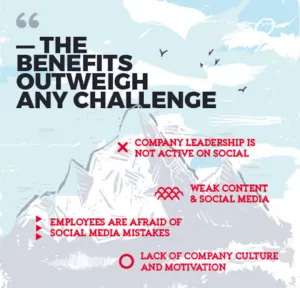
Employee advocacy challenges are none too surprising, but the benefits of implementing an advocacy process will outweigh any challenge your company may face. Over the last few years, employee advocacy has become an important process to many medium, large, and enterprise companies across various industries.
It’s more than just a buzz term, it is an essential process that can help boost employee engagement, increase social and marketing reach, help generate better quality leads, and much more.
During our research for our employee advocacy guide, we found some interesting stats:
Also, a Nielsen study showed that 84% of people trust recommendations from friends, family, colleagues over other forms of marketing. And these are just a few we found quite important.
You can see why so many companies take employee advocacy seriously.
Yet, as with any new process or program, there will always be some challenges that need to be addressed.
Below are a few common employee advocacy challenges your company may face and how you can start to solve them right now.
As you begin to discuss with your colleagues or employees, you may get pushback as to the purpose or why employee advocacy even matters.
And since you’re introducing something new (and potentially a new program) that employees will be using, the question is quite common.
Before trying to jump into a sales or marketing pitch about employee advocacy, it’s better to convey how everyone will play a part in the success of the company.
It’s also not something every employee should feel required to participate in.
Instead, employees should feel inclined to add value to help their company and want to become thought leaders in their space.
You especially do not want to put pressure on your team and fellow employees. Instead, show them why this actually helps the company grow.
In order for you to convey the importance of employee advocacy, everything needs to be transparent as to how it benefits the company.
This includes:
For employee advocacy and advocacy software to be effective, there has to be a unique company culture that employees value.
When it comes to employee advocacy challenges, your company advocacy will fail if company culture is completely lacking.
Without a sense of being connected or a company culture employees can trust, how could you expect employee advocacy to be successful?
Employees who feel disconnected, a distrust of the leaders/company, or are unsatisfied with the company are not going to care about the success of employee advocacy and will be less motivated to participate.
It’s important to recognize right from the start if there is a lack of company culture and feeling of dissatisfaction among employees.
Before any employee advocacy process (or program) is in place, begin working on any issues with the company culture. Looking to build a team of more engaged employees? Here are 4 Ways to Improve Employee Engagement Now. Have you ever be inclined to share content or be an advocate for a brand that has terrible policies, negative news, or continues to receive terrible feedback from customers and employees?
The same applies to employees.
Why would they want to promote a company that other than a paycheck, provides little to no value to them?
In order to start improving culture, gather feedback from employees and hear their ideas, concerns, and let them ask questions candidly. They are the best source of where gaps of bad culture can be repaired.
Additionally, research companies that are known for their company culture and learn what they do differently and what works for them.
Gathering this kind of information along with your employee feedback will help get your company on the right path.
Employees will more likely be advocates and will join in employee advocacy if there is solid culture.
Take the steps to improve the culture and the rest will fall into place.
If you are reading this post, more than likely you are familiar with how important social media plays into employee advocacy success.
Company leaders and the senior or manager level employees should be advocating alongside their colleagues. This sets the “lead by example” tone for employee advocacy.
If company leaders are not active on social media, sharing content and engaging with their industries, why would employees want to join as well?
Granted, the C-Suite may have limited time to always be sharing and engaging, but spending a few minutes a day can make all the difference in overall advocacy success.
It’s obvious too when companies have a great employee advocacy in place and their C-Suite/Senior level employees are active on social.
One great example is product management software Aha!.
The company founders and leaders are consistently active on social media where they interact, share articles, write blog posts, and ask their contacts questions.
And if you look at other employees from Aha!, they are all doing the same.
This effect is contributing to Aha’s business growth, interactions on social, and overall brand visibility.
Get your leaders active and engaging on social now.
The easiest ways to get leaders on board is to provide examples of companies whose leaders are highly visible on social.
Always backup examples with statistics (even screenshots of the various shares, likes, comments) to show how engagement can contribute to company success.
One of the larger employee advocacy challenges is when companies have a weak content strategy and social media presence.
Let’s break these specific employee advocacy challenges down a bit further. Content Strategy Most times companies want to continue to promote their own products or services, however, this is a mistake.
It’s better to create a content strategy that focuses on who the prospective buyers are and answer their questions via articles.
The more you give to your targeted audience, the more likely they are to convert on your product, services, or buy what you are selling.
It might not be in that first initial post, but content marketing contributes to your lead generation.
Yet, content is also important as you are encouraging employees to share it with their networks.
If your content strategy is weak or all self-promoting, employees are going to be less interested in posting to their connections. Need some more content strategy tips? Learn How to Improve Your Business Branding with Content. As you are gearing towards an employee advocacy platform, a lot of content can also be from third-party sites, industry related news articles, or even establish guest bloggers for your company.
This will establish the brand, company, and employees as a go-to source for anything related to a specific industry. Social Media The process of social media and even access to interacting on social can be a challenge right from the start.
Many companies are also notorious for blocking social media websites.
This is a mistake, especially when considering employee advocacy. Social is a huge factor for success, but there are other reasons to get your company on board to unblocking social accounts.
As mentioned in the beginning of this post:
That right there tells you exactly why access to social networks is actually a good thing.
(If you are looking for more, this article on Monster makes a great case for unblocking social media within your organization.)
Another issue is if your social accounts and/or your employees’ accounts are not consistent, set-up correctly, or very active.
Before employee advocacy can work, encourage employees to spruce up their profiles.
Allow employees to post more articles, interact with relevant industry connections, and begin building some traction before engaging in employee advocacy.
After all, if accounts look weak or nothing of value is being shared, employees will not be seen as thought leaders in their space.
Maybe your company already allows social activity or your company is just started unblocking social media sites, yet employees still aren’t really posting on their accounts.
What gives?
A clear social media policy should be in place, one that everyone has access too and one that the leaders of companies are also following.
Employees may be unsure of what is okay to post, how often, or generally concerned with inadvertently posting something that upsets the company.
Feeling concerned about what they post and facing repercussions of their social actions can certainly scare people from engaging in their social networks.
So before any employee advocacy program is in place, make sure your company has a strong set of guidelines set or re-fresh them to fit in with your new advocacy solution.
Along with that, it makes sense to have a point of contact within the company that employees can be trained by or someone they can go to ask questions specific to social media. Looking for some policy examples? Here are 7 Sample Social Media Policies for Employees.
While it may seem common and important for social media and marketing teams to own employee advocacy, there are many other departments this should apply to also.
Now ideally most, if not all employees should be involved as it will help increase your marketing reach, drive web traffic, generate more leads, improve recruiting, and ensure your brand is highly visible.
However, as you begin to roll out employee advocacy, it makes sense to incorporate specific departments and be methodical at first with who participates.
Other teams that should be included are sales, communications, and HR teams.
But in general, it is important to help employees see why employee advocacy matters while keeping participation completely voluntary.
Many employees may think it should only be marketing’s job only, but convey the following:
As you begin to explore or adjust your employee advocacy, you may look at the initial employee advocacy challenges and be discouraged.
However, you also are familiar with how an employee advocacy program not only benefits your company but employees as well. Looking for employee advocacy inspiration? Here are 10 Brands That “Get” Employee Advocacy. Companies like Dell, HPE, Adobe, and many others have recognized the value of not only employee advocacy but a program that their employees can easily interact with daily.
And while there are a few employee advocacy challenges to consider, the common ones your company may face are relatively easy to start correcting.
Just remember: communication, establishing a great company culture, simple training, and sharing social guidelines will all ensure your company continues to overcome employee advocacy challenges.
Todd served as Director of Marketing at EveryoneSocial, leading content strategy and editorial across the blog through 2021. Today he is Head of Content & Brand at RemoFirst, founder of Linkeezy (an inbox and content tool for LinkedIn), and a SaaS marketing and content advisor.
See the platform that comms, marketing, and compliance teams use to run their advocacy program.

