 LoginSchedule demoLoginSchedule demo
Ready to strengthen your LinkedIn content strategy? Here are the three must have tactics and strategies to generate strong social media ROI.


I think we can all agree that LinkedIn is the professional social network that helps drive sales, retain customers, build brand affinity, and attract top talent to open job positions.
Yet we still see LinkedIn content strategy poorly executed or even neglected today.
If you want to drive real growth through this social network, there are ultimately three main ways to do that:
Below, I’ll get into the strategy behind each of these, complete with tips and examples to ensure you have a strong LinkedIn content strategy going forward. Let’s dive in!
If you lead social media for your organization, then you’re likely familiar with employee advocacy or have at least heard the term before.
The concept is simple: It’s all about enabling employees to be social, so they can drive attention both to the company and to their own personal brands.
A few years ago, that would give every company a heart attack.
For quite some time, the train of thought was, “No way are we going to let employees have access to social media at work. What if they say something that reflects poorly on the brand!?”
Sure, there are probably plenty of company executives that STILL think that today. But it’s outdated thinking, especially given how today’s buyers conduct product research.
In fact, more than 90% of B2B buyers and more than 80% of senior executives use social media for research before making purchasing decisions.
Social platforms will always prioritize the individual, whether you’d like to think that or not. Mostly because:
Now, company pages are definitely still important and impactful (see below), but individuals outperform them. And unfortunately, the majority of B2B companies have weak company page Linkedin content strategy.
Luckily, you can tap into the power of individuals by encouraging your people to create, share, and engage with content on social media. Ingrain this into your culture, lead by example, make social media a part of the onboarding process for new hires, and provide resources, training, and the right tools.
Everyone in your org has an influence and has expertise/experiences to share. Let them do it, or get left behind as employees at your competitors dominate the social feeds.
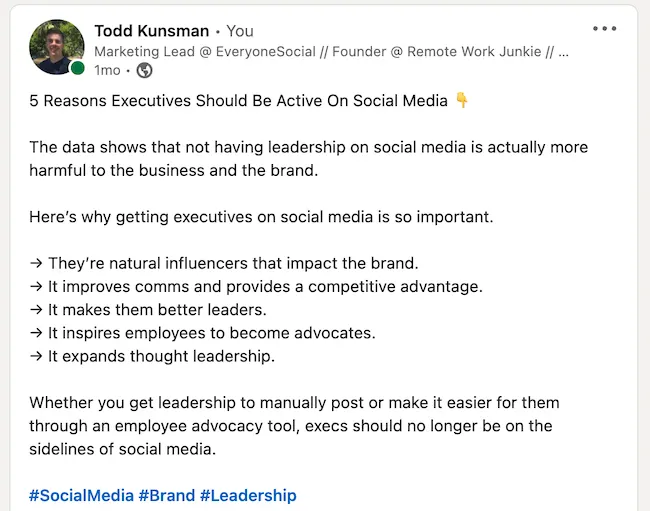
Skeptical? Or maybe you get it, but would love to see some data to back it up?
We’ve got you covered. Here’s a sample of some data around the value of employees on social media
Related: Curious what kind of results your company could achieve with employees sharing content? Calculate your employee advocacy ROI in under 30 seconds.
The founders or executives leading the organization must be on social media today. Period. It’s the best way to tell the company’s story, mission, and values.
And people want to hear from leaders of the company, whether it’s about the business or industry they represent or their own personal insights.
While people want to hear from your brand’s employees, the company’s execs are the face of the brand, so they’re essential to building trust and fostering interest on social media.
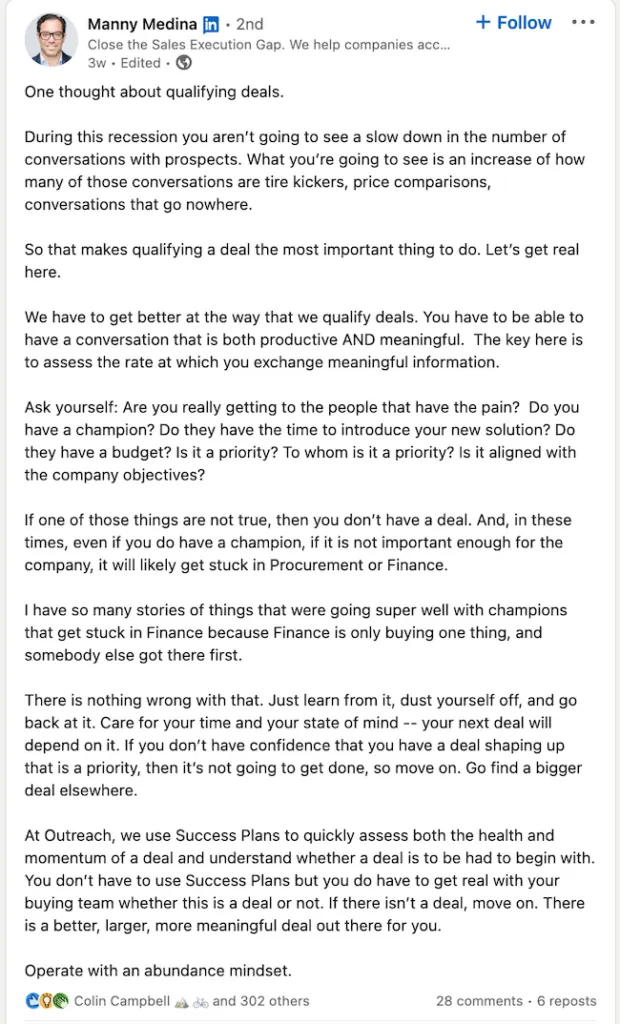
Typically, founders and executives have some of the best reach on social media. Mostly because people like to understand and learn from those who have experience starting a company or leading the organization.
And even if your executive team doesn’t have much of a following yet, once they start getting consistent with social media you’ll notice their accounts begin to snowball in growth.
A LinkedIn content strategy where executives are involved does a few things:
And, most importantly, when other employees see execs taking social seriously, it encourages them to share online as well. Leading by example is another way to encourage employee advocacy (back to #1 above).
The main challenge is that leaders have to BELIEVE in social media. If they still see it has a commodity or waste of time, it’ll be near impossible to convince them otherwise.
And unfortunately, there probably isn’t much that can be done until they see the value for themselves — like AmFam CEO Jack Salzwedel does — or start opening their minds a bit further. But if they’re onboard, here’s how they can get involved:
We covered a lot about executives on social media, so make sure you check out this in-depth post with tips and more examples.
Although individuals take priority in social media, it doesn’t mean your branded company pages should be ignored.
But it can be difficult to make company accounts stand out when LinkedIn prioritizes individuals and paid advertising. Seriously, I was looking at a few brand accounts on LinkedIn that have millions of followers, and most of their posts reach just 1% of that.
Another reason company pages sometimes fall flat is simply because they’re boring and too formulaic. It usually follows the pattern of blog post link, product link, event link, and open job link.
While we don’t know all the intricacies of LinkedIn’s algorithm, its goal is to keep users on the platform and consuming content in their feeds, so links are often deprioritized, especially if that’s all you post on your company page.
And, honestly, you probably don’t care too much about a company’s self-promotional stuff unless you’re a customer, investor, or employee, right? So why is that the only thing your company page is doing?
The formula of a successful company page shouldn’t be too surprising and is much simpler than you may realize. The main challenges for most social media managers — or companies that don’t have an in-house social media expert — are the following:
Here’s how you can approach a LinkedIn content strategy for the brand page:
→ Post educational and unique content 90%+ of the time. Save the sales pitch and requests to download/join things to 10% or less.
→ Post 5-6 times per week, like clockwork. Consistency is imperative.
→ Add creativity and establish a brand voice. Yes, even those stuffy corporate industries need to do these things.
→ Comment as the brand on relevant content and respond every time someone tags or comments on your company content. This shows that you’re paying attention and engaging with user..
Want to see a brand that does this incredibly well?
Look at Remote, which comments on others’ content almost daily. This consistent engagement helped the brand gain hundreds of followers a day and surpassed 200k company page followers as of this writing.
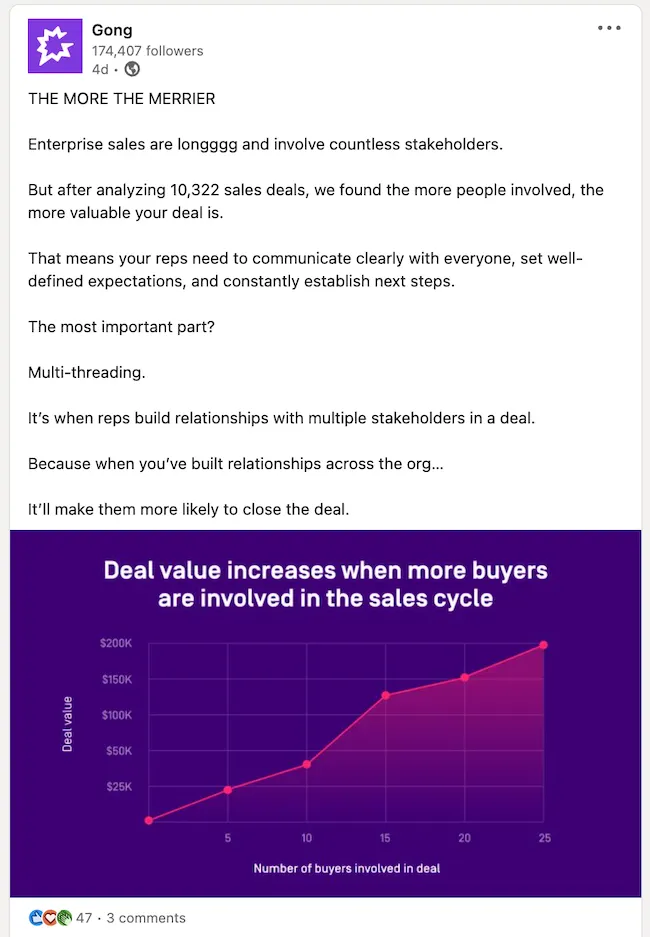
Another great example is Gong, a company page that has an amazing LinkedIn content strategy that fueled both its growth and its brand affinity. Their LinkedIn content strategy includes all the tactics from this post, which helped them reach unicorn tech status.
You may have noticed that my above tactics do not include LinkedIn ads.
Are ads still relevant for an effective LinkedIn content strategy? Yes.
Are they absolutely necessary to drive results? Not really.
I see LinkedIn ads as an additional lever to pull once your other LinkedIn content strategy tactics for this social network are in place. A few reasons for this:
Often companies jump to paid ads before they really have a strong LinkedIn content strategy figured out or even their best target audience. This can result in wasting thousands of dollars.
LinkedIn ads are certainly an effective channel, but they’re costly, so think of them as the icing on the cake to your overall strategy.
In my opinion, LinkedIn is one of the best social networks for B2B and SaaS organizations to establish credibility and drive revenue today.
Will that happen overnight for your brand? Of course not, but your content strategy on this social network can pay huge dividends for years to come.
As you think about a deeper LinkedIn content strategy, you really need the three key areas I discussed in this article: employees, founders/execs, and the company page. And you can utilize LinkedIn ads to further reach your ideal customers.
However, the above three tactics will do amazing things for your brand, marketing, sales, and recruiting efforts. So what are you waiting for?
See the platform that comms, marketing, and compliance teams use to run their advocacy program.

