
When firms talk about social media compliance, they often jump straight to policy.
What can employees say? What needs approval? What should marketing encourage? What should compliance restrict?
But SEC Rule 17a-4 forces a more basic question underneath all of that:
Can the firm actually retain covered LinkedIn communications in a compliant, defensible way?
For a lot of broker-dealers, that is where the real problem starts.
They already have an archive strategy for email. They already have systems for other digital channels. They may already work with an enterprise archiving vendor. They may even believe LinkedIn is fully covered.
Then they look closer.
And what they find is usually some version of the same story: some employees are covered, some are not; some activity is captured, some is not; and the areas with the most uncertainty are often the ones carrying the most risk.
That is not a small technical gap. It is a recordkeeping gap.
What Rule 17a-4 Really Forces Firms to Prove
At a practical level, Rule 17a-4 raises the bar on three things in the social media context.
Retention for the required period
Most covered electronic communications must be retained for at least three years, with the first two years in an easily accessible location. That clock starts when the communication is created — not when the firm discovers it exists.
Preservation in WORM-compliant format
Records must be preserved in a “write once, read many” (WORM) format — meaning they cannot be altered or deleted after capture. This is the technical standard that distinguishes compliant archiving from simply saving screenshots or exporting PDFs. A folder of LinkedIn screenshots does not meet this standard.
Completeness of covered business communications
The rule requires retention of communications “relating to the firm’s business.” This is the part that creates the most friction on LinkedIn. Not because firms disagree that the rule matters, but because they often do not know how complete their LinkedIn retention program actually is.
That last point is the one that matters most.
A firm saying “we retain LinkedIn” does not tell you much. The better question is: which LinkedIn records, from which employees, under what workflow, and how completely?
Why LinkedIn Creates a Retention Problem Faster Than Firms Expect
LinkedIn feels familiar. That is part of the problem.
Because it feels like a normal professional platform, firms often underestimate how many different kinds of business-relevant activity can happen there, including:
- public posts
- comments and replies
- resharing firm content with added commentary
- articles and newsletters
- profile updates tied to role or credentials
- direct messages with prospects, clients, recruiters, or peers
Not every action carries the same compliance significance. Context matters. Role matters. Substance matters.
But once LinkedIn becomes part of how representatives conduct business, a firm cannot base its retention strategy on the idea that only the most obvious actions count.
This is exactly where the partial coverage gap shows up.
A firm may preserve certain public-facing activity while missing comments. It may have some visibility into posts but less confidence around direct messages. It may assume a vendor covers everything when only selected activity is actually retained. It may rely on screenshots or manual retrieval processes that do not meet WORM preservation standards.
That is how firms end up with partial compliance dressed up as complete compliance.
The Most Common 17a-4 Problem Is Coverage Drift
Most firms do not have a knowledge problem here. They have a drift problem.
Enrollment drift
The original rollout covered a defined population, but no durable process was put in place for new hires, transfers, acquisitions, or long-tenured legacy employees.
Activity drift
The retention model reflects an older, narrower view of LinkedIn usage than what is happening now. A configuration set up in 2021 may cover posts and DMs but miss comments, reactions, or LinkedIn newsletters — formats that did not exist or were not widely used when the system was deployed.
Vendor assumption drift
The firm assumes LinkedIn is already handled because it has an enterprise archiving provider like Global Relay, Smarsh, or Proofpoint. But the actual configuration, scope, and completeness have never been validated against current employee usage.
Visibility drift
The compliance team cannot answer a simple question cleanly: how many of our supervised or regulated employees are currently active on LinkedIn?
That last one matters more than it sounds.
You cannot close a recordkeeping gap you cannot size.
What “Business Communication” Looks Like on LinkedIn
This is where firms usually want a bright line.
They rarely get one.
The SEC has not published a definitive list of which LinkedIn activities count as business communications. But based on enforcement actions and guidance, the general framework is becoming clearer:
Almost certainly covered: Direct messages between a registered representative and a client, prospect, or business contact discussing products, services, or investment strategies.
Likely covered: LinkedIn posts and comments by registered representatives that relate to the firm’s products, services, or investment strategies.
Gray area: Reactions, endorsements, connection requests, and general professional content sharing. The SEC has not specifically addressed these, but the trend in enforcement has been toward broader interpretation, not narrower.
The practical takeaway is straightforward: if LinkedIn activity meaningfully intersects with business communication, the firm should not build its retention posture around wishful interpretations. Since 2021, SEC, CFTC, and FINRA enforcement actions related to electronic communications have resulted in more than $3.5 billion in fines across the industry — and the regulators’ position has consistently been that the obligation to retain belongs to the firm, regardless of whether the firm has the technical infrastructure to capture every channel.
What a Stronger 17a-4 Approach Looks Like
A more defensible LinkedIn retention model usually includes:
A current inventory of active employees on LinkedIn
Not who is assumed to be there. Who is actually there.
Role-based enrollment logic
The right people are brought into the program systematically — not through one-time cleanup projects that go stale within a quarter.
Specific understanding of captured activity
Compliance can say what is and is not retained today, with clarity — which activity types, from which employee populations, in which WORM-compliant archive.
Integration into the broader archive posture
LinkedIn should connect to the firm’s real recordkeeping model — feeding the same compliant archive (Global Relay, Smarsh, Proofpoint, etc.) that handles email and other channels — not sit off to the side as a special case.
Regular validation
Because employee populations change, platform behavior changes, and policy assumptions age quickly. Quarterly reviews of enrollment completeness and capture scope should be standard practice.
This work is less glamorous than rewriting policy language. It is also where the strength of the retention program actually comes from.
Start with Reality, Not Assumptions
A lot of firms assume their LinkedIn retention posture is in better shape than it really is because pieces of a program already exist.
The smarter move is to validate.
How many LinkedIn-active profiles exist across your regulated population? How many of those are under the right archive and supervision workflows? Where does your capture model stop short of how the platform is really being used?
Those are the questions that make Rule 17a-4 operational instead of theoretical.
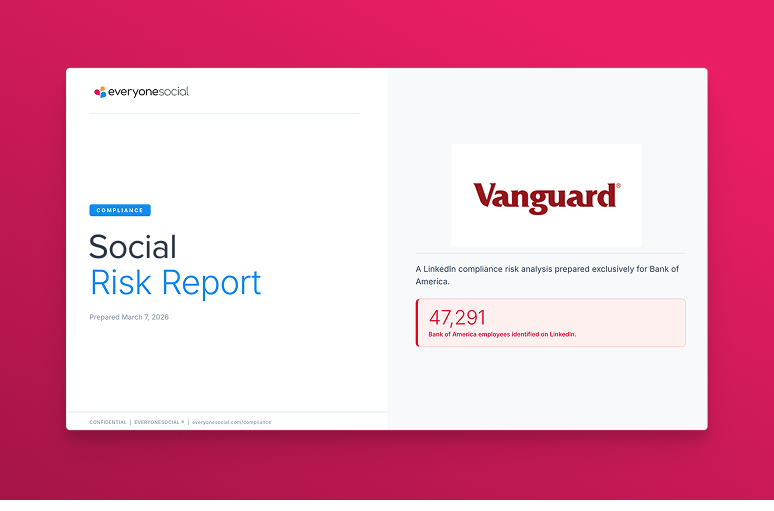
EveryoneSocial helps firms answer them with a LinkedIn Compliance Risk Report that surfaces likely visibility and coverage gaps across LinkedIn usage. It gives broker-dealers a practical starting point for improving retention, supervision, and defensibility.