
Most firms do not have a FINRA social media compliance problem because they have never heard of the rules.
They have one because LinkedIn turns familiar rules into messy operational questions.
A compliance team can understand FINRA Rules 2210, 3110, and 3120 very well and still have a weak LinkedIn program. That is because the hard part is not naming the rules. The hard part is translating them into classification, supervision, and testing workflows that hold up against the way employees actually use the platform.
That is where many firms are shakier than they think.
LinkedIn is now a real business channel. Advisors build visibility there. Firms distribute thought leadership there. Professionals prospect there. Recruiters compete there. Executives shape perception there. Private and public interactions happen side by side.
Once that is true, the question is not whether the firm allows social media.
It is whether the supervisory model matches reality.
Rule 2210: LinkedIn Content Still Has to Be Governed
Rule 2210 classifies communications into three categories, and the classification determines what level of review is required.
Institutional communications are directed at institutional investors. These require policies and procedures for review but do not necessarily need pre-approval.
Retail communications are directed at more than 25 retail investors within a 30-day period. These generally require principal pre-approval before first use, or within 10 business days of first use if the firm has filed them with FINRA.
Correspondence is directed at 25 or fewer retail investors within a 30-day period. This requires supervision but not necessarily pre-approval.
Here is where LinkedIn makes this complicated: a post on a registered representative’s profile is visible to their entire network — often hundreds or thousands of contacts, many of whom are retail investors. FINRA has indicated that public social media posts generally qualify as retail communications, meaning they may require principal review or pre-approval.
Comments and replies sit in a grayer area. FINRA has acknowledged that interactive electronic communications (real-time conversations) may be treated more like correspondence. But a substantive comment on a public post could also be considered a retail communication depending on content and reach.
That is why LinkedIn creates classification problems faster than many firms expect.
The issue is rarely that employees are intentionally trying to violate policy. It is that they are publishing and amplifying business-related communications through patterns the firm does not classify consistently.
And once classification gets fuzzy, supervision gets fuzzy right behind it.
A strong program needs more than abstract guidance. It needs examples rooted in LinkedIn reality so employees and reviewers understand the difference between acceptable participation, content requiring approval, and content likely to trigger review.
Rule 3110: The Supervisory System Has to Work in Practice
Rule 3110 is where LinkedIn compliance becomes real.
It requires firms to establish and maintain a supervisory system reasonably designed to achieve compliance with applicable securities laws and regulations. That includes written supervisory procedures (WSPs) that address how the firm monitors and reviews social media activity.
This is the point where many firms discover that their written procedures sound better than their actual operating model.
A policy may say social media is supervised. But what does that really mean?
- Does the firm know which associated persons are active on LinkedIn?
- Are those people actually enrolled in the right workflows?
- Which types of activity are monitored — posts only, or also comments, DMs, and profile changes?
- How are potential issues surfaced and escalated?
- Who reviews what, and how frequently?
- How is evidence of review documented?
- Do the WSPs still reflect the way LinkedIn is used today, or were they written three years ago and never updated?
Those are operational questions, not drafting questions.
And they matter because a supervisory system is only as strong as its actual coverage.
A lot of firms still rely too heavily on self-disclosure, manual spot checks, or loosely connected processes that create the appearance of oversight without creating a durable system behind it. FINRA examiners regularly review firms’ WSPs as part of routine exams, and a common finding is exactly this gap — firms with social media policies on paper that are not consistently followed in practice, particularly around LinkedIn.
That might limp along in a small environment. It tends to break down at bank or brokerage scale.
Rule 3120: Testing Is Where Weak Programs Get Exposed
Rule 3120 requires firms to test and verify their supervisory procedures and conduct annual reviews.
This is often where LinkedIn programs show their weakest seams.
Because once controls are tested against reality, the same issues tend to show up:
- supervised populations are incomplete
- business units interpret policy differently
- account disclosure is inconsistent
- captured activity does not fully match expected coverage
- review workflows are not tuned to real LinkedIn behaviors
- written supervisory procedures no longer match how the channel is actually used
That is why annual review should not be treated like a checkbox exercise. On LinkedIn, it is one of the clearest opportunities to validate whether the supervisory model still reflects the real channel.
If your firm’s supervisory control system does not include LinkedIn-specific testing — verifying that monitoring systems are capturing the activity they should be capturing, that reviews are happening on schedule, and that issues are being escalated and resolved — that is a gap FINRA examiners are increasingly likely to identify.
The Biggest FINRA Gap Is Usually Not a Bad Post
When firms think about LinkedIn risk, they often focus first on content risk.
Promissory language. Misleading claims. Performance references. Testimonials. Obvious red flags.
Those matter. But the deeper structural issue is usually supervisory coverage.
If a firm cannot identify its LinkedIn-active associated persons, it cannot supervise them consistently. If it cannot map real platform behavior to the right workflows, it cannot prove consistency. If it never tests LinkedIn usage against enrollment, capture, review, and exception handling, it cannot know whether the system is actually working.
That is why LinkedIn compliance is a supervision problem before it is a content problem.
The risky post is visible. The incomplete supervisory model is the bigger institutional risk.
What a Stronger FINRA-Aligned Program Looks Like
A stronger LinkedIn supervision model usually includes:
Clear guidance on how LinkedIn activity should be classified
Employees need practical examples — not just abstract policy references — that map real LinkedIn behaviors to retail communication, correspondence, and institutional communication categories under Rule 2210.
Documented review workflows tied to real risk triggers
The firm can explain who reviews what, when, under which triggers, and how that review is recorded.
Exception-based monitoring that scales beyond manual universal review
At scale, human review of every LinkedIn post is not realistic. Automated keyword-based monitoring can flag potentially non-compliant content — specific product names, performance claims, guarantees, testimonials — so the compliance team focuses attention where it matters.
Alignment between policy language and actual platform use
WSPs should reflect how LinkedIn is actually used inside the firm today, not how it was used when the policy was last updated.
Regular testing against real employee activity, not just written intent
Quarterly validation of enrollment completeness, capture scope, review cadence, and exception handling — documented and defensible.
That is when FINRA social media compliance starts to look like an operating discipline instead of a policy appendix.
Start with Visibility
The first step is not more theory. It is visibility.
Who is active on LinkedIn across your supervised population? What are they doing there? How much of that activity is under current workflows? Where is the firm stronger in policy than it is in operational control?
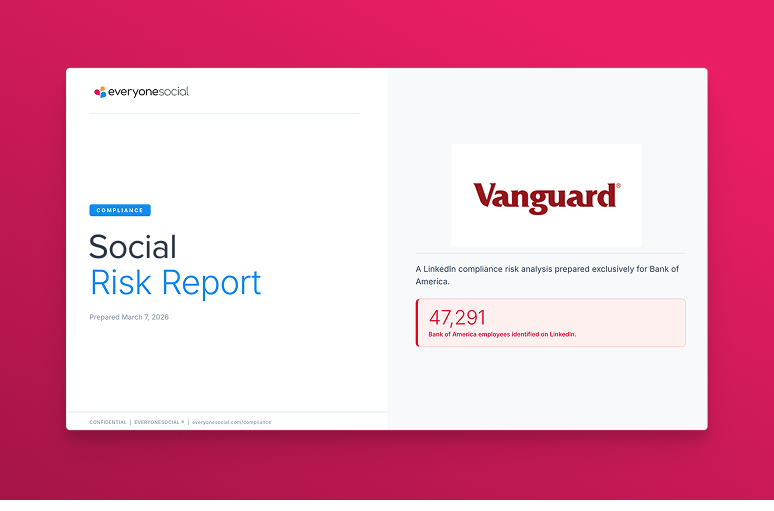
EveryoneSocial helps firms answer those questions with a LinkedIn Compliance Risk Report that identifies active professionals, likely coverage gaps, and places where LinkedIn usage may be outpacing current supervision.