

LinkedIn Compliance for Banks: Why Large Institutions Struggle More Than They Think
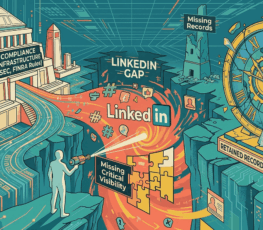
LinkedIn compliance is harder for banks than it looks from the outside.
Not because banks are careless. Not because compliance teams are asleep. And not because the rules are unusually obscure.
It is harder because banks are large, layered institutions trying to govern a channel that employees use constantly, unevenly, and often outside the neat boundaries of traditional communications workflows.
That makes LinkedIn a scale problem before it becomes anything else.
Inside a bank, LinkedIn activity does not sit neatly in one department. Wealth professionals use it one way. Commercial bankers use it another. Recruiters use it differently. Mortgage teams, branch leaders, executives, analysts, investor relations, and corporate communications all touch the platform with different goals and different patterns of behavior.
Some publish thought leadership. Some mostly reshare. Some use direct messages heavily. Some mainly update profiles, build presence, and engage in comments.
From a distance, that can all look like normal professional networking.
From a compliance standpoint, it creates a fragmented, moving target.
Why Banks Are More Exposed Than They Think
Banks face LinkedIn compliance pressure from multiple angles simultaneously.
The employee base is broad.
A mid-size bank might have 5,000 employees. A large bank might have 50,000 or more. A significant percentage have LinkedIn profiles. A meaningful subset are active daily. The relevant population extends far beyond one obvious regulated group — it includes anyone in client-facing, advisory, or management roles who may be considered a “supervised person” or “associated person” under applicable regulations.
Regulatory breadth compounds the challenge.
Large banks are often registered as broker-dealers, investment advisers, and banking institutions simultaneously — meaning they are subject to SEC, FINRA, OCC, FDIC, and potentially state-level regulators. Each may have slightly different expectations around electronic communications retention. LinkedIn activity may need to be archivable and supervisable across multiple regulatory frameworks.
Ownership is fragmented.
Marketing may drive visibility. Compliance may own policy. IT may own systems. HR may influence recruiting-related activity. Business units drive actual usage. No single team has the full picture by default.
Workforce movement never stops.
People join, leave, transfer, change titles, move between functions, and take on roles with different supervision expectations. Any program built on static enrollment lists will drift. Determining which employees need LinkedIn archiving and supervision — and which do not — is a classification exercise most banks have not fully completed.
The channel is decentralized by design.
Unlike email, which flows through centralized, firm-controlled servers, LinkedIn activity happens on a third-party platform. Employees act through individual profiles, often from personal devices, in moments that feel informal. Traditional compliance infrastructure was not designed for this kind of distributed activity.
This is why so many banks have the same problem in disguised form: policy language exists, some technology exists, some workflows exist, but practical control is still more partial than anyone wants to say out loud.
The Hidden Problem Is Usually Visibility
A lot of banks feel more comfortable than they should because they already have a social media policy and an enterprise archive provider.
Those are important foundations. They are not proof of coverage.
The more revealing questions are usually these:
- How many employees at the bank have active LinkedIn profiles right now?
- Which of those employees are in roles that create heightened supervision or recordkeeping expectations?
- Which of them are actually enrolled in the right workflows?
- Which LinkedIn activities are being captured consistently — posts only? Comments? DMs?
- Where does public activity or direct interaction exceed the bank’s current level of oversight?
These are simple questions on paper. In large institutions, they are often surprisingly hard to answer with precision.
And that is the real exposure.
A bank does not need a rogue employee problem to have a LinkedIn compliance problem. It only needs incomplete visibility into a channel that a large workforce is already using for real business purposes.
The enforcement landscape makes this more urgent than it used to be. Since 2021, SEC, CFTC, and FINRA enforcement actions related to electronic communications — including social media — have resulted in more than $3.5 billion in fines across the industry. Regulators have investigated firms of all sizes for failures to retain off-channel communications, and their position has been consistent: the obligation to retain belongs to the firm, regardless of whether the firm has the technical infrastructure to capture every channel.
Why Restriction Alone Usually Fails
Some banks try to solve the issue by limiting who can post, discouraging participation, or creating such approval-heavy processes that employees stop trying.
That may reduce visible activity. It rarely solves the underlying problem.
Employees still maintain profiles. They still engage in comments. They still connect with prospects and peers. They still respond to recruiting conversations. They still move discussions into direct messages. And the bank still wants many of those people visible because LinkedIn matters for recruiting, trust, brand perception, and relationship-building.
So the institution ends up with the worst of both worlds: lower business value and continued unmanaged activity.
The banks making progress are not trying to wish the channel away. They are trying to govern it more completely.
The Bank-Specific Gaps That Show Up Again and Again
Across large institutions, a few patterns repeat.
Legacy enrollment gaps
The original program covered part of the workforce, but long-tenured populations were never fully cleaned up and later expansion stalled out. A bank might have enrolled 200 registered reps when the LinkedIn program launched three years ago — meanwhile the actual LinkedIn-active regulated population has grown to 2,000.
Role complexity
The bank’s workforce includes a mix of regulated, supervised, client-facing, executive, and recruiting-heavy roles, but the governance model does not map neatly to that complexity.
Disconnected advocacy and compliance motions
Marketing is running an employee advocacy program that encourages people to share content. Compliance has limited insight into how that content is actually shared and discussed at the user level. The firm wants more employee visibility but enablement and governance developed on separate tracks.
Weak oversight of interaction-heavy activity
Public posting gets the attention. Comments, replies, and direct messages — arguably the highest-risk channels — often create the less visible supervision challenge. Many banks only archive and supervise public posts, not DMs.
Institutional inertia
Everyone agrees the issue matters, but because LinkedIn touches multiple teams, ownership gets diffused and progress stalls. The LinkedIn gap persists not because nobody cares, but because no one function can solve it alone.
What Better Actually Looks Like
A stronger LinkedIn compliance model for banks starts with realism.
Assume LinkedIn usage is broader than the bank’s current enrollment data suggests. Assume employee behavior spans more formats than policy examples imply. Assume workforce movement will keep creating drift unless the operating model is built to absorb it.
From there, better usually looks like:
A clear inventory of active LinkedIn users across relevant employee groups
Role-based enrollment logic that keeps pace with workforce movement — so new hires, transfers, and role changes automatically trigger the right level of archiving and supervision.
Capture tied into the bank’s broader archive posture — feeding directly into the same compliant archive (Global Relay, Smarsh, Proofpoint, Shield) that handles email and other channels, rather than sitting off to the side as a special case.
Supervision built around exception handling and scale — automated keyword-based monitoring that flags content for human review, because no compliance team can manually review thousands of LinkedIn posts per week.
Pre-approved content and governed enablement — a curated content library that gives employees compliant content to share with one click, reducing the volume of ad-hoc, unreviewed posts while increasing the business value of participation.
Regular governance reviews — quarterly validation of enrollment completeness, capture scope, and workflow effectiveness.
That is how banks move from partial oversight to something more defensible.
The Better Mindset
The banks with the strongest programs do not treat LinkedIn as an edge case.
They treat it as a real institutional channel.
Once you do that, the conversation changes. It is no longer “Should we allow this?” It becomes “How do we govern this completely enough to support the business and stand up to scrutiny?”
That is the smarter question.
EveryoneSocial helps banks answer it with a LinkedIn Compliance Risk Report that identifies active LinkedIn populations, likely coverage gaps, and areas where the bank’s current workflows may not match real platform use.